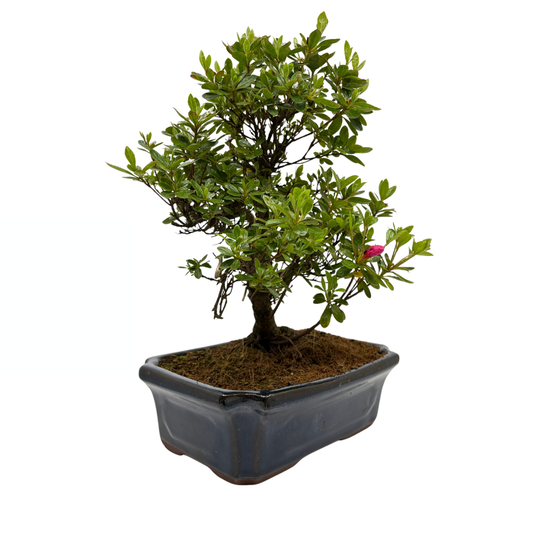
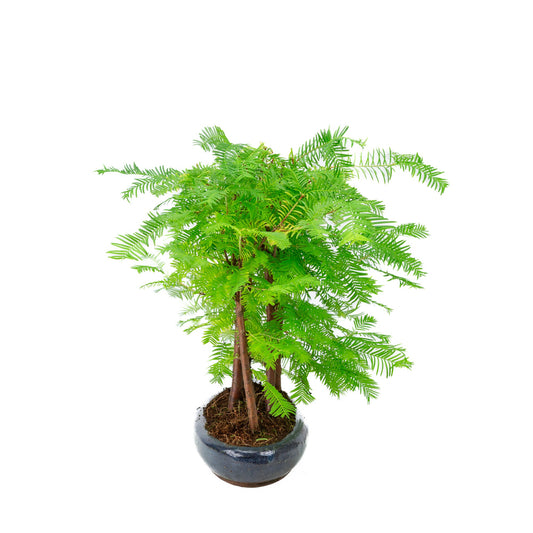
Bonsai care

Would you like to purchase a bonsai but are you unsure about its care? This article provides all the essential information about bonsai care. We explain what bonsai is, why caring for a Bonsai isn't actually difficult, and offer practical tips on watering, fertilizing, pruning, and location. You'll also read about common mistakes and how to avoid them. With the right approach, you can enjoy your bonsai for years to come!

Bonsai tree

What is Bonsai?

Bonsai is a Japanese word that literally means "planted in a pot." It originated in China, where people began cultivating trees in containers millennia ago. Only much later did the Japanese adopt this art form and perfect various techniques, such as pruning and wiring. Around 1900, bonsai spread to Europe, where it was first presented to the public at the World's Fair in Paris.

Despite popular belief, bonsai is not a tree species, but a collection of techniques for cultivating, shaping, and caring for trees with the aim of reflecting nature as closely as possible. The trees can grow very old and are passed down through generations in Japan; one of the oldest trees is over 800 years old and can be found in Shunka-en (Tokyo).

Are Bonsai trees difficult to care for?

No, it's actually quite easy. For most tree species, basic care is very simple: regular watering and proper placement. Tree species like Ficus , Japanese Elm ( Zelkova ), and Ligustrum, for example, are very strong and can also be kept indoors. Subtropical tree species are often more difficult to care for because they require plenty of light and high humidity. For outdoor use, there's a much wider selection, such as Azalea , Maple , Pine, or Juniper.

So why does it still seem difficult? This has a lot to do with the fact that people are used to caring for "normal" houseplants; these are planted in much larger pots and therefore have more water storage. If you forget to water your bonsai, it immediately becomes a problem because it doesn't store water in its small, shallow pot. If you're careful about watering regularly and place your bonsai in the right (sunny!) spot, there won't be a problem!

The basics of Bonsai care

Watering bonsai

Unlike regular houseplants, bonsai trees are often placed in very small containers. This means there's little room to store water and requires frequent watering. However, the frequency of watering depends on factors such as pot size, soil mix, tree species, and climate. So don't just water every 'x' number of days, but observe it: water your bonsai thoroughly as soon as the soil begins to dry out slightly. Check this by feeling the top layer of soil with your finger. A bonsai should absolutely never be left dry.

Location

Most tree species prefer plenty of light and a constant temperature. Keep in mind that some trees can only be kept indoors (particularly subtropical trees), while others thrive outdoors (even in winter). We also have an article about selecting the right bonsai tree species .

If you want a tree for your living room, choose a (sub)tropical tree like a Ficus, Carmona, Jade, Privet, or Zelkova. These trees love lots of light, and only a south- or west-facing window will provide sufficient light. Therefore, don't place the tree on a table more than a meter away from the window. Avoid placing it directly above a radiator or near an open window.

Fertilize

Bonsai trees need to be fertilized throughout the growing season to replenish the necessary nutrients. For outdoor trees, this is during spring and summer, and for indoor trees, year-round. There are fertilizers specifically formulated for bonsai, but you can also use other types as long as the NPK values ​​are suitable. Don't overfertilize; the trees are in small pots and therefore need less food than regular plants.

Pruning

Pruning to maintain the overall shape of the tree can be done year-round. Special twig shears are helpful, but regular household shears can also be used for pruning twigs. Concave pruning pliers are only recommended when pruning thick branches, as they create wounds that heal better. Read more about choosing bonsai tools .

Repotting

Bonsai should be repotted every 2-3 years to prevent the roots from completely filling the pot. The best time is in early spring, just before the tree begins to sprout. During repotting, some of the roots are pruned and the tree is placed in fresh bonsai soil. Read more about choosing the right bonsai pot .

Choosing the right soil is important for healthy bonsai. Good drainage is especially crucial to prevent root rot. For developing bonsai and indoor bonsai, our standard bonsai potting soil is perfectly suitable. For outdoor trees, we recommend a mix of Akadama with a draining product like Vulkastrat, Bims, or Kiryu. These mineral components ensure optimal air and water permeability.

Winter care

Outdoor trees need their cold winter dormancy to stay healthy. Therefore, leave these trees outside, even in frosty weather. Protect the pot in severe frost (below -10°C) by burying it or covering it. Indoor trees can stay indoors year-round, but be sure to protect them from cold drafts from windows or doors.

Flora and fauna

We grow bonsai as responsibly as possible at our nursery, without using harsh pesticides. This means your bonsai may be infested by insects at some point. You can easily rinse these away with a strong jet of water or treat them with a mild pesticide. It's best to repeat the treatment three times, with weekly intervals.

The two most common mistakes

Not watering properly

One of the most common mistakes is underwatering or forgetting to water. Because bonsai are placed in small pots, the soil dries out quickly. Therefore, check the soil daily for moisture, especially during the warm summer months when evaporation is high. And when you water, do so thoroughly, ensuring the entire root ball is moist. For indoor bonsai, we recommend watering in the sink and replacing the tree after it has drained.

The wrong place

Another mistake is placing indoor trees in too dark a spot. Tropical bonsai like Ficus , Zelkova , or Carmona need plenty of light to stay healthy. Therefore, place them in a bright spot, preferably directly in front of a south- or west-facing window. Too little light leads to weak growth, leaf drop, and aphids.

The most common mistake with outdoor trees is keeping them indoors, especially during the winter. Outdoor trees like Japanese maples and junipers belong outside all year round. Keeping them indoors during the winter is particularly damaging, as it disrupts the natural winter dormancy the tree needs to stay healthy. Without this cold period, the tree weakens and can even die.

Bonsai inspiration: Taikan-ten exhibition

Questions about your bonsai?

Bonsai are living works of art that can bring you years of joy and relaxation. Caring for a bonsai is a meditative practice that brings you closer to nature. Upon delivery, we do our utmost to send you a good and healthy bonsai. After that, its health depends on its location and the care you provide.

With every bonsai we ship, we share comprehensive care tips. We've also created a comprehensive online information platform: Bonsai Empire . We've also developed our own smartphone app: the Bonsai Care App (available as a free download in app stores).

If you have any further questions, please do not hesitate to contact us.